Infant car seats
While infant car seats function the same, different regulations and testing standards exist across distinct regions of the world. I’ll be focusing primarily on European Union here. This chapter will include links to different seat models, these are included as examples for clarity and are not product endorsements.
Sizes and groups
Car seats are categorized in broadly 3 groups:
| Group | Approximate age | Requirements | Description |
|---|---|---|---|
| Group 0 | 0 to 15 months | Height 40-85cm Weight <13 kg | Exclusively rear facing. Also known as bucket seats |
| Group 1 | 6 months to 4 years | Height 61-125cm Weight <22 kg | Rear and forward facing. Also known as combination seats |
| Group 2/3 | 4 to 12 years | Height 100-150cm Weight <40 kg | Exclusively forward facing. Also known as booster seats |
Warning
Child’s “age” does not matter and is included just for estimation purposes. What actually matters is baby’s height and weight. When your baby exceeds the maximum height or weight (whichever comes first) the car seat stops providing adequate protection and has to be changed. One of the most common errors resulting in injury is using an inappropriately sized car-seat. Always check the manual to ensure your child fits correctly.
I say “broadly” because some models are size-adjustable and can cover multiple groups.
-
Bucket seats (group 0 exclusively): These are rear-facing and can be used until approximately one year of age. This is the only category that supports detaching the seat from the base while the child still strapped in and mounting the seat onto a 3-in-one modular travel system. It is a good option if you favor portability and not waking up the baby when the car-ride ends. For example Maxi Cosi 3 in 1. If you are considering a 3-in-1 travel system I encourage you to read about sleeping in a car seat.
-
Convertible car seats (both group 0 and 1): Opposed to the bucket seats described above these have a much larger usage span and generally last from birth to 4 years. They are bigger, heavier and not designed for portability (you can’t detach this seat from the base with the baby strapped in). This category support both forward and rearward facing positions and generally feature a rotating base for easier loading and unload of the child. For example Cybex Sirona T i-Size is such a seat.
-
Booster seats (both group 2 and 3): Are modular and change configuration based on child’s age: starting with
5-point-harness + high-back-boosterand progressively transition intohigh-back-booster + car's beltandno-back-booster + belt. An example of a seat in this group BeSafe Flex FIX. This category of seat is exclusively forward facing, does not rotate and is attached directly to the car’s car’s ISOFIX mounts. Usually much cheaper than seats of group 0 and 1. -
Evolutive car seats: These models cover all three groups and can be used from birth until your child can use the car’s seatbelt. The ergonomics sometimes suffer in favor of adjustability (depends on both the seat model and the child). This is by far the most cost-effective option. Chicco EVO i-size is a seat of such type.
To my knowledge most common route is to get a convertible car seat (birth to 4 years) and transition into a group 2/3 seat later.
Standards
- R129 also known as i-Size is the latest safety standard at the time of writing (2026). Any infant car seat sold in the EU since 2014 is required to have this certification. To obtain it, different seat models are tested for frontal(50 km/h), side(30km/h) and rear(30km/h) impacts. More about testing methodology in this article.
- R44 is the older mandatory standard. These car seats can still be legally used, but not sold by retailers. Unlike R129, these car seats are not rated for side-impacts. This is one of the main reasons they are being phased out.
- Swedish plus is a voluntary test manufacturers can undergo. It mostly focuses on frontal collisions measuring the forces applied to the neck and spine in case of an accident. Premium brands will have this certification in addition to the mandatory R129.
- ADAC is the german counterpart to the Swedish plus test. These tests are performed independently without manufacturer opt-in (the organization itself chooses what models to test). Evaluation results can be found on their official page. ADAC results for 2025
These accreditations will be mentioned on seller’s web-site or are present as a sticker on the seat itself.
Installation
ISOFIX
ISOFIX is a standardized European system for securing child car seats. It uses rigid connectors attached to the vehicle’s chassis for a more secure fit. These connectors are located on the backseats of the car, on the lower side of the backrest. All cars sold in europe since 2012 are required to have ISOFIX mounts, but even older cars are likely to have them.
Infant car seats can be installed either onto a dedicated base or secured using car’s 3 point harness.
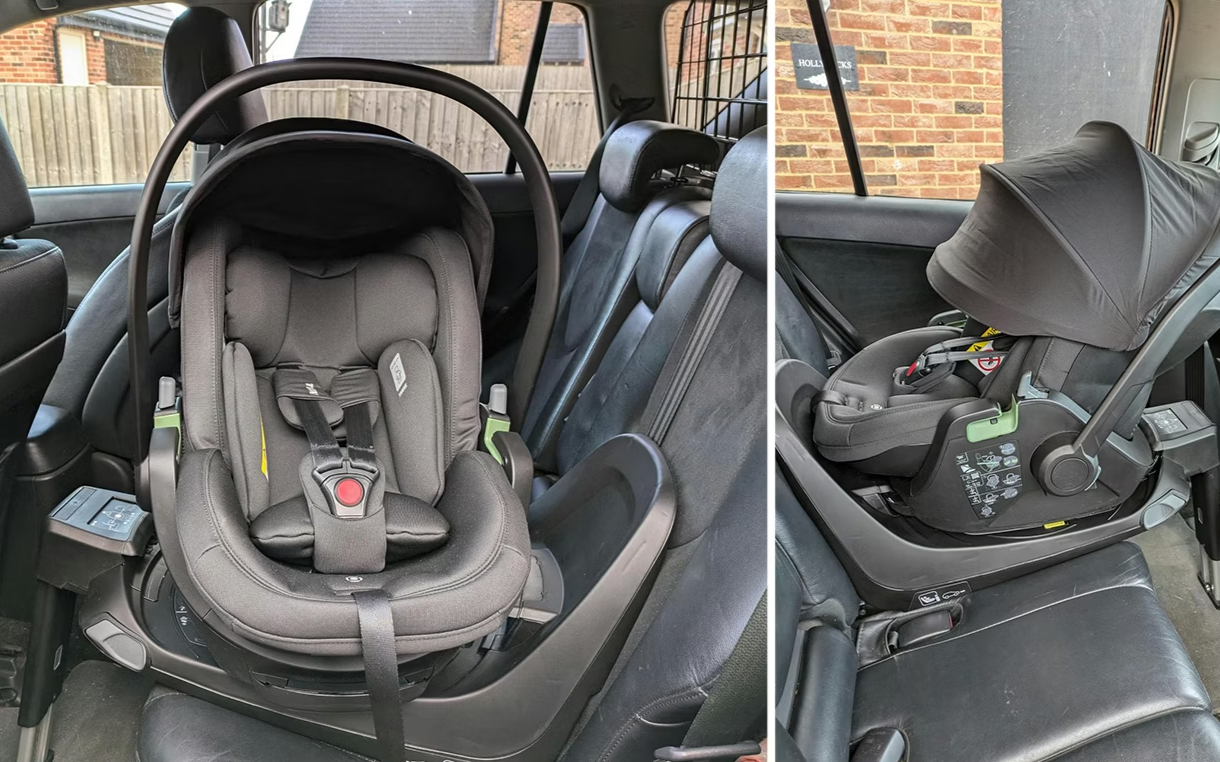
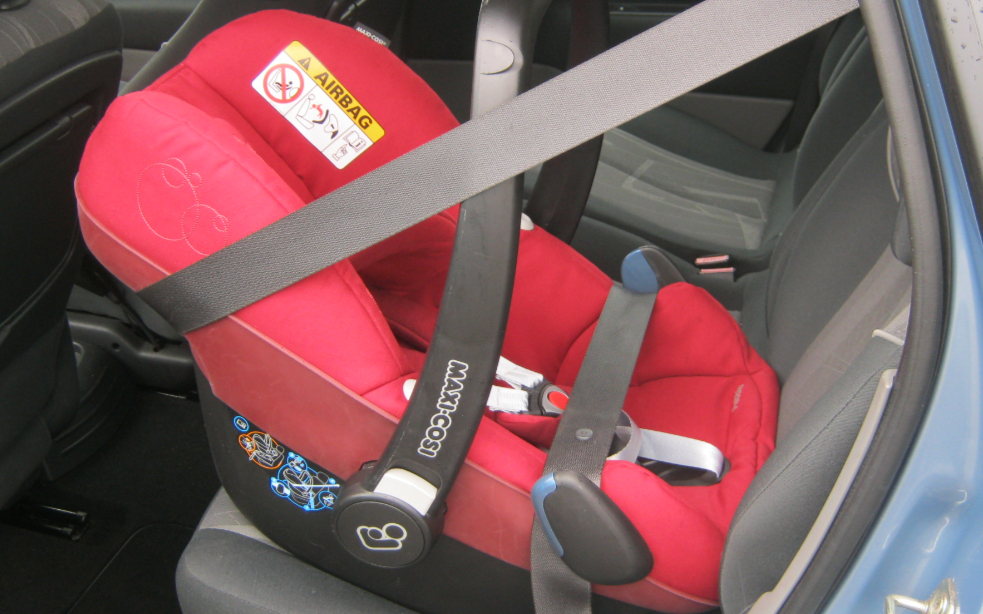
The base is attached to the ISOFIX mounts and seat clicks into the base. Generally using a base allows you to rotate the seat by 90 degrees for loading and unloading your child. In my opinion the extra convenience of being able to rotate the seat is worth the extra cost of purchasing the base.
The ISOFIX mounting option is considered safer, as it eliminates a majority of common installation errors and reduces car-to-car variability.
Position in the car
The rear middle seat is the safest location in the car for an infant car seat, while the front passenger seat is the most dangerous.
Overall, the rear (2nd row) seating positions have a 29.1% (Univariate Analysis, p < .0001, OR 1.29, 95% CI 1.22 - 1.37) increased odds of survival over the first row seating positions and the rear middle seat has a 25%
Journal of Safety Research V39
Regulations differ from country to country, but as a generality infant car seats are not legally allowed to be installed in the front of the car besides special cases (for example car does not have rear seats or all rear-seats are occupied by other children).
If the infant car-seat is installed in the front row of the car, in the majority of cars the car’s seat must be moved all the way back and the passenger air-bag is manually deactivated. A deployed airbag can propel a rear-facing infant car seat into the backrest potentially causing serious head and spine injury.
Warning
Correctly installing the infant car seat in the front row differs from car to car. Your car’s manual will have a chapter dedicated to this, you must read it and ensure it is done properly. Do not rely on generalities for this step.
The airbag must be turned off via mechanical means (usually a key on the side of passenger’s dashboard). Do not rely on software deactivation for this!
I recommend watching this video for more details on front installation.
Installing in the back is much less complicated, generally the side-airbags of the car should remain engaged, but always consult your car’s manual to ensure correct installation.
Forward or rear facing orientation
Babies between approximately 0 and 15 months must be seated rear-facing, failure to do so will result in a fine (beside it being a bad idea).
In EU children over 15 months are allowed to sit forward facing but is the less safe option. Based on this Swedish report from all fatal injuries from 1992 to 2024, 47% of fatalities could have been avoided if the child were restrained in a rear-facing car seat. Sweden has been one of the main advocates for rear-facing seating and their recommendations advocate for exclusive rear-facing seating as long as possible, at least until age of 4/5. The Folksam safety rating program from the same conference goes into some details.
Infant car seats in group 2/3 are almost exclusively forward facing. There are some group benders like the BeSafe beyond that allows rear-facing seating until approximately 6 years (125 cm height and 22kg), but it’s the only example so far. At this age children stop having enough legroom in a rear-facing position, and they weigh too much for the seat effectively manage the downwards rotation, so forward-facing sitting position is the only feasible option.
Warning
Never travel with your child facing sideways. It is extremely unsafe and illegal. I saw a staggering amount of people swivelling a car seat so it faces side window.
Sleeping in the car-seat
Is it safe to sleep in a car seat?
While the answer is quite straight-forward the guidelines seem to be in contradiction with each other:
According to safe sleep guidelines sleeping in baby containers is not allowed, and an infant car seat is a baby container, so no?
At the same time nhs advices taking breaks every 2 hours and not letting the baby sleep in a car seat that longer than necessary, so yes?.
Also why does it matter if the car is moving or not?
So what’s the danger and are you supposed to wake a child that fell asleep in a car seat?
The main risk of sleeping in a car seat is positional asphyxiation. The baby can slump forward or sideways obstructing their airways causing difficulty in breathing. This is an example of a dangerous position: Group 1 and 2 car seats are designed for the baby to sit in a semi-reclined 45-degree angle. Sitting at this angle provides the best protection in a crash while limiting the probability of positional asphyxiation during limited use. Research shows that the more time a newborn spends in the same position the higher the probability of positional asphyxiation.
The secondary risk of sleeping in the car seat is overheating. These seats are made of thick materials which retain heat. Excessive heat is one of the risk factors for SIDS considering the underdeveloped self-cooling mechanisms of a young baby.
Both of these risks can be managed by active adult supervision. So yes, a child can sleep for a short duration (1-2 hours) during trips while an adult is monitoring their position.
Why should you remove them from the car seat after the trip has ended: Notice that the actual seats in cars are tilted slightly backwards. The engineering of infant car seat takes that into account the car’s natural seat inclination and compensates for it. Placing a baby car seat on a flat surface increases the sitting angle and makes slumping much more likely. This also explains why 3-in-1 travel systems are generally considered safe for supervised sleep only when attached to a compatible base. The base is designed to offer an appropriate sleeping angle and there is an adult keeping an eye on the baby.
Warning
A car seat should never be used for unsupervised sleep.
Even positional asphyxiation aside, there are multiple reports of babies waking up and entrapping themselves on the belts, falling from elevated surfaces (in case the car seat is placed on a table) or injuring themselves by tumbling sideways together with the seat, or people forgetting a sleeping baby in a hot car.
Generally a bad idea. You should move the baby onto a suitable sleeping surface after the car ride has ended.
This is good blog post on the topic of car seat sleep safety
About used car seats
Used car seats should generally be avoided for these 2 reasons:
Infant car seats are rated for exactly one crash, and should be discarded after an accident. This is why you are not allowed to return or exchange a car seat after it exited the shop. Retailers can’t resell it as they can’t prove the seat was not involved in a crash.
Pro-tip: Brick and mortar shops will often have “showroom seats” that you can lease for a short duration. This allows you to test if the seat fits in your car and if your child sits conformably, before commiting.
Also, keep in mind that infant car seats expire—typically 6 to 10 years after they’re made. You can find the exact date on a sticker attached to the seat. Over time, heat and UV rays break down the plastic; even if no damage is visible on the outside, the internal foam (EPS) can degrade, failing to provide proper protection during a collision.
Purchasing a secondhand car seat requires you to rely on the seller’s honesty regarding its accident history while also verifying that the seat hasn’t reached its expiration date.
Extra safety features
This section goes through the distinct safety features different models of infant seats might have.
In truth, few people should care about this. To get the mandatory R129, any car-seat will be tested and is guaranteed to offer adequate protection. Some more premium brands might have multiple redundant protections, in case one system fails, the other one picks up the slack, but some skepticism is required: more addons does not necessarily mean safer. The only real way to know if a seat is safer than the other is via ADAC or Sweedish Plus or any other independent testing organization.
This section goes into some details on how this extra safely features work and what is their purpose.
Infant car seats have to manage three primary safety aspects: side impact protection, downwards rotation and ensuring the child is seated correctly.
Side impact protection
The R129 simulates a side-impact collision at 24km/h and benchmarks the forces acting on child’s head, neck and torso.
Virtually all modern baby car seats will feature a rigid outer shell made out of molded plastics and sometimes a steel reinforcement. Underneath it is a layer of shock absorbing materials, usually polystyrene and/or polypropylene.
In addition to this, some of the more premium brands will offer either a SIP or a pop-up crumple wings as a redundancy. A SIP (side impact protector) is detachable airbag that is mounted to the baby seat itself, one example of a seat featuring a SIP is BeSafe Beyond.
A crumple wing is an extendable wing that absorbs shocks and transfers it to seat’s shell (similar to a SIP), one example is the Cybex sirona.
Downward rotation
This is concerned with frontal impacts also tested by R129 at 50km/h.
In a sudden stop, inertia pushes the car seat forward and causes it to rotate. Once the vehicle stops completely, the seat may rebound, flipping back toward the car’s backrest. This behavior is called “downwards rotation” and “rebound” respectively.
The ISOFIX mounts or belts (depending on the installation mode) will do most of the heavy lifting here. A majority of models in group 0 will feature some sort of anti rebound bar. In case there is slack on the belts or the base is not correctly installed (and downwards rotation is not managed correctly) the anti-rebound bar acts as a barrier between the child and the backrest of the car.
The load-leg of the base serves a similar purpose, but instead of managing rebound, it ensures the seat does not rotate forward by anchoring it to the floor of the car.
A top tether functions the same as a load-leg. Instead of anchoring the seat to the floor of the car (push), it uses a third anchorage point that connects the top of the infant car seat to the car via an extra belt (pull).
Five point harness
The five point harness is not mandated by R129.
This type of harness prevents what is colloquially called “submarining”, where the child’s body slides down, causing the belt to move from their rib cage onto the softer abdominal area (potentially leading to internal injuries on emergency breaking).
By virtue of being more restrictive the five point harness does not allow incorrect seating positions and also prevents older babies from “escaping from the straps”.